AUTHOR MANUSCRIPT · SIAM JOURNAL FORMAT · 2026
Preprint · Not peer reviewed or journal accepted
Residual-Budgeted Inexact Contour Moments
for Nonlinear Eigenvalue Problems
Accuracy control for contour-based nonlinear eigenvalue solvers using physical residuals, extraction-aware error budgets, and shared-basis cluster allocation.
ABSTRACT
From physical residuals to extraction-level accuracy budgets
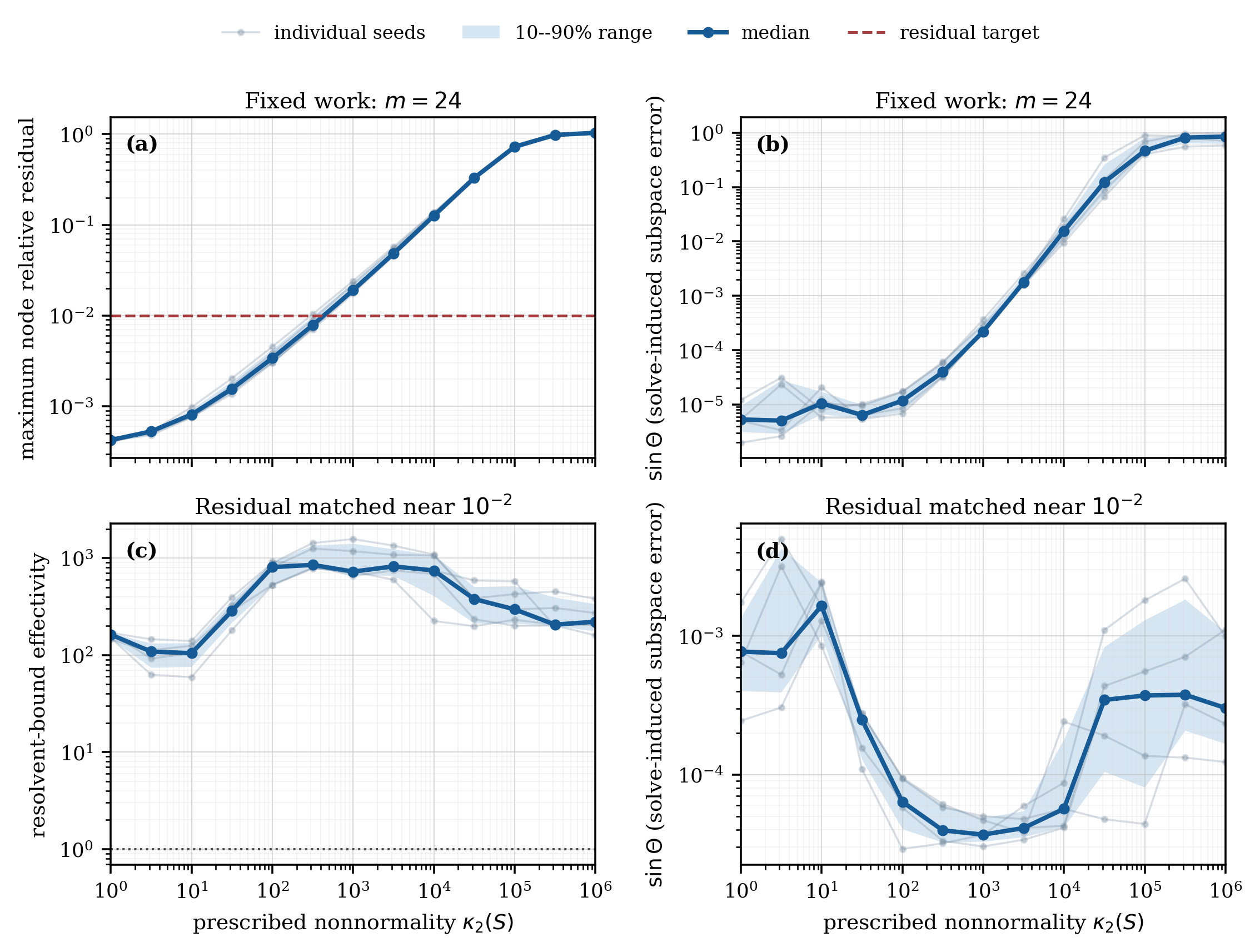
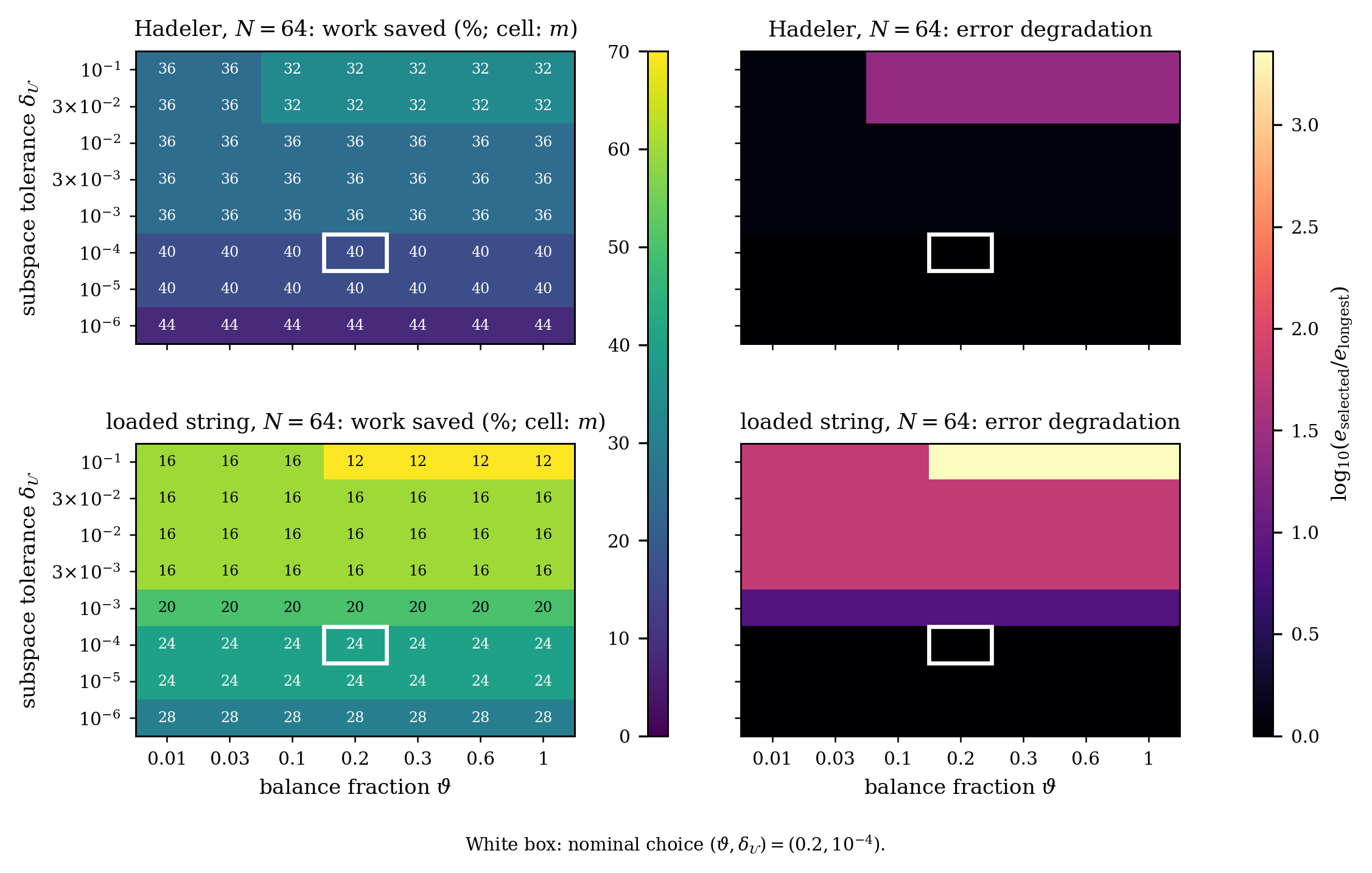
Contour-integral solvers for analytic nonlinear eigenvalue problems require linear solves at many quadrature nodes, often using shared infinite-GMRES bases. We develop an accuracy-control framework for centered Beyn extraction that converts physical node residuals into computable moment, subspace, and eigenvalue perturbation budgets. The weights reflect the quadrature rule, local resolvent behavior, and extraction objective, enabling node- and cluster-aware work allocation. A nested quadrature comparison estimates the discretization scale, while a singular-subspace guard prevents premature stopping. Reproducible experiments on a nonnormal analytic family and two NLEVP benchmarks empirically support the bounds and show that safeguarded stopping preserves the observed accuracy plateau with less counted Arnoldi-prefix work.KEY CONTRIBUTIONS
A residual-budgeted theory for inexact contour moments
The analysis keeps solver error, discretization scale, extraction sensitivity, and shared-basis work allocation distinct.Physical residual identity
Derives a residual-to-centered-moment identity and a resolvent-weighted bound for block analytic nonlinear eigenvalue problems.
Direction-sensitive budgets
Connects inexact moments to Keldysh subspace perturbations and an exact reduced-operator identity for eigenvalue enclosure.
Two independent guards
Balances solve error against nested quadrature variation while a singular-subspace guard blocks premature rank decisions.
Node and cluster awareness
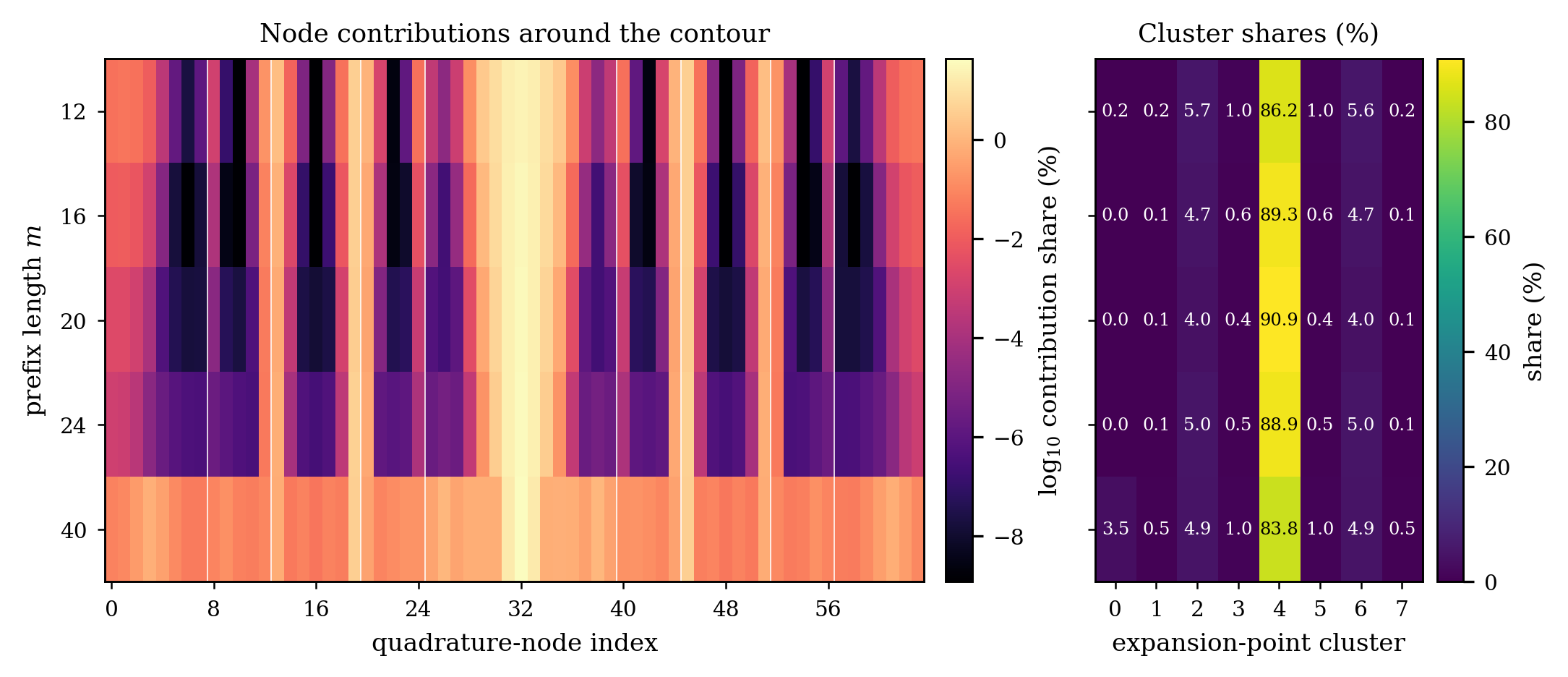
Allocates tolerances across contour nodes and shared infinite-GMRES bases using extraction-aware contribution weights.
ANALYSIS PIPELINE
Five layers from node solves to reported eigenvalues
Each layer has a separate diagnostic, so a small linear residual is not mistaken for a reliable extracted spectrum.- 01
Physical residuals
Evaluate the original nonlinear system residual at every contour node, rather than relying on an internal Krylov proxy.
- 02
Moment propagation
Weight nodewise residuals by quadrature coefficients, centered monomials, and local inverse-operator sensitivity.
- 03
Subspace guard
Track the extraction-relevant singular subspace and refuse stopping when its separation is too fragile.
- 04
Reduced operator
Propagate moment error through the centered Beyn reduction to obtain a structured eigenvalue perturbation budget.
- 05
Shared-basis work
Allocate the remaining budget across nodes and expansion-point clusters that share infinite-GMRES prefixes.
REPRODUCIBLE EXPERIMENTS
Stress tests reveal where residual-only stopping fails
INTERPRETATION BOUNDARY
Reported savings are retrospective counts of retained Arnoldi-prefix iterations, not measured wall-clock speedups. Experimental resolvent bounds use double-precision singular values and are numerical-oracle bounds, not outward-rounded certificates.
CITATION & STATUS
Cite this work as a manuscript/preprint
This page is a stable portfolio record and download location. It is not a journal DOI record.Y. Liu, Y. Zhan, J. E. Roman, and M. Shao, Residual-budgeted inexact contour moments for nonlinear eigenvalue problems, manuscript/preprint, 2026. Available at: https://yaoyaozhan.site/papers/rbicm-2026.
@unpublished{liu2026residual,
  author = {Yuqi Liu and Yaoyao Zhan and Jose E. Roman and Meiyue Shao},
  title  = {Residual-Budgeted Inexact Contour Moments for Nonlinear Eigenvalue Problems},
  note   = {Manuscript/preprint},
  year   = {2026},
  url    = {https://yaoyaozhan.site/papers/rbicm-2026}
}
Download the complete 19-page manuscript
Open PDF manuscriptSIAM journal formatting · theory, algorithms, limitations, and extended experiments.
Publication-status notice. This document is an author manuscript/preprint and has not undergone peer review or been accepted or published by SIAM or any other journal. Use of the SIAM LaTeX style does not imply SIAM affiliation, endorsement, or publication.